
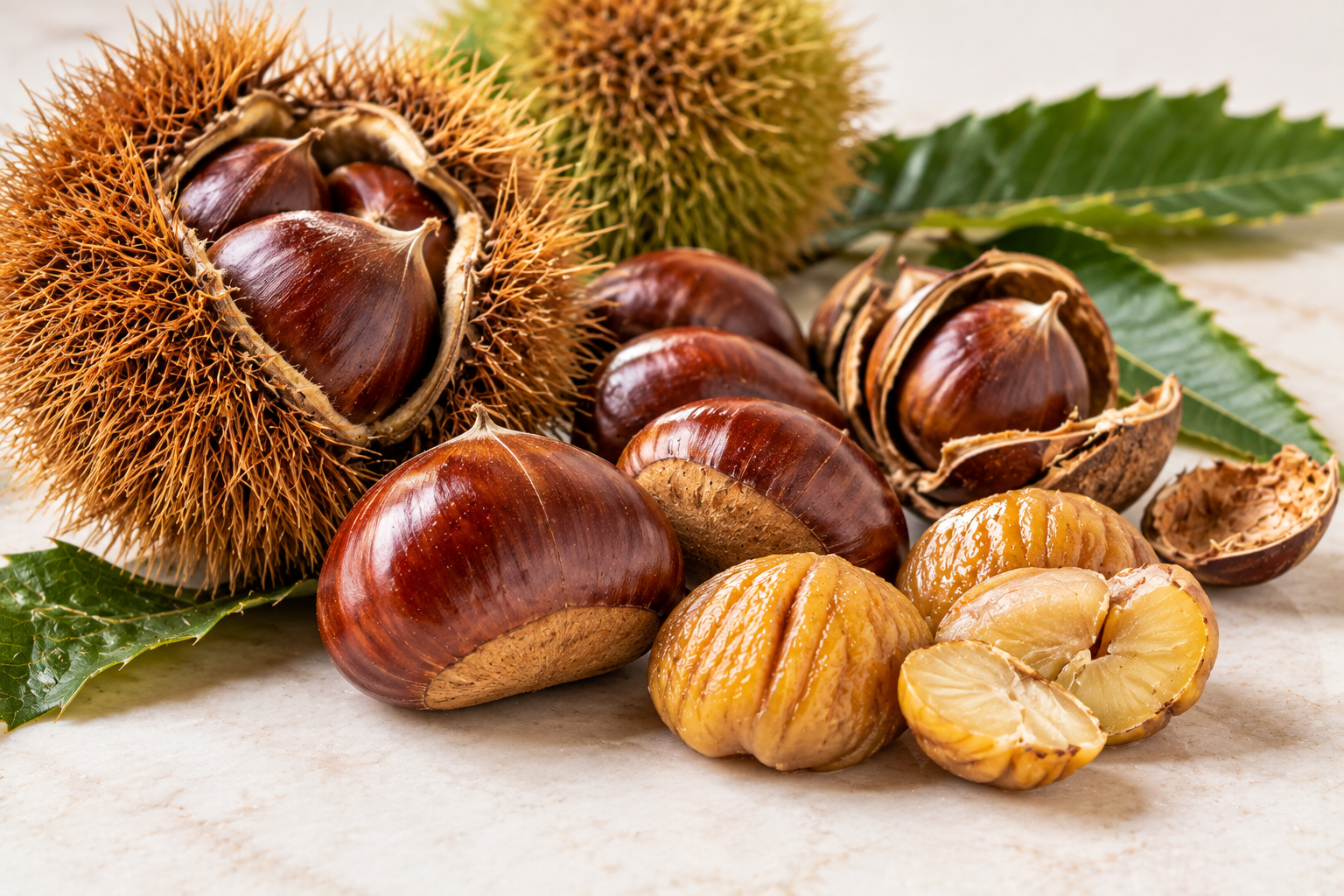
Chestnuts show up in one song and one paper cone, and then vanish for a year.
That’s a shame. October through December is the only stretch when fresh ones are worth buying — and almost everything the word “nut” promises you, a chestnut quietly declines to deliver.
Barely a nut
Here’s the clearest tell. Leave pecans or walnuts in a warm cupboard too long and they go stale and oily, because the fat in them has turned. Leave chestnuts in that same bowl and they shrivel, or grow mold. You are not dealing with the same kind of ingredient.
Hold a fresh chestnut in one hand and a pile of almonds in the other, and you’re holding mostly water and starch on one side, mostly oil on the other.
So heat doesn’t crisp a chestnut. It cooks it, the way heat cooks a bean or a parsnip — the inside goes tender and crumbly, mildly sweet, with a smell nearer to warm bread than to toasted nuts.
Stop waiting for crunch and everything else falls into place. The chestnut isn’t competing with pecans at all. It’s a soft, starchy, gently sweet thing that wants salt, fat, and something sharp nearby — which puts it closer to the vegetables on your table than to the bowl of nuts beside them.
That’s also why chestnut keeps turning up in this year’s fall cooking. The flavors quietly replacing pumpkin spice — brown butter, maple, cider, toasted pecan — are built on depth rather than spice, and chestnut is the one that brings body.
Buying them
Fresh chestnuts go downhill faster than any other nut, and most disappointing chestnuts were already disappointing in the store.
Pick one up. A good one feels heavy for its size, with a taut, glossy shell and no holes, splits or soft patches. Press gently — there shouldn’t be any give between the shell and the nut inside.
Then shake it. A rattle means the inside has dried out and shrunk away from the shell, and roasting won’t bring it back.
At home they belong in the fridge, in a bag, not in the fruit bowl. They’re full of water, and left at room temperature they dry out or go moldy within days. Cold, they’ll hold about a week to ten days.
Score them first. This part isn’t optional.
A raw chestnut is a sealed shell packed with wet starch. Heat it and that water turns to steam with nowhere to go — and eventually, loudly, it finds somewhere.
So cut through the shell before it goes near the oven. Sit each nut flat side down and cut one long slit, or an X, across the rounded top with a sharp paring knife or kitchen shears — through the shell, not deep into the nut. Work slowly and keep your fingers well back; the shells are hard, round and fond of rolling.
If they fight you, soak them in water for half an hour first. A softened shell cuts much more easily.
Roasting them
Hot oven, around 425°F. Chestnuts in a single layer, cut side up, twenty to twenty-five minutes. They’re done when the shells curl back at the cut and the nut gives easily to a knife tip.
Then peel them hot — this matters more than the roasting does. There are two layers: the hard outer shell, and a papery inner skin that clings into the grooves and carries a faintly bitter edge. Both come away willingly while warm and stubbornly once cool. Keep the batch wrapped in a towel, peel a few at a time, and mind the steam.
What a chestnut wants on the plate
Chestnuts are generous but vague. Body and soft sweetness, almost no edge — so they’re happiest beside ingredients that supply what they’re missing.
Salt, above all. It’s doing two things here. The chestnut’s sweetness is faint enough to walk straight past, and salt brings it up where you can hear it; at the same time it quiets the small bitterness that papery inner skin leaves behind. Eat a warm chestnut alongside prosciutto, a shaving of hard aged cheese, or nothing fancier than flaky salt, and the seasoning isn’t really what you notice. The nut comes into focus.
Fat, because the chestnut brought so little. Butter is the straightforward answer; butter cooked until it smells toasted and nutty is the better one, handing the chestnut exactly the richness it was born without.
Dark sweeteners rather than plain sugar. Maple, sorghum, molasses — not to push the sweetness higher, but for the shadow each one carries underneath it. Maple’s is dry and faintly resinous, with a cool whisper of smoke that a mild nut has plenty of room for. Maple is odd that way: sap sweetness and maple-wood-smoke sweetness come off the same tree and taste nothing alike.
Woody herbs. Sage, thyme, a bay leaf dropped into the pot. Sage crisped in butter is practically automatic with chestnuts, and it earns the habit — its sharp, almost pine-needle edge gives all that softness a corner to bump into.
Something sharp at the end. Starch and fat get heavy fast. A few turns of black pepper, a little lemon, a handful of pomegranate seeds — any of them is the difference between finishing the bowl and leaving half of it.
Two easy ways in
Crumble warm peeled chestnuts into browned butter with a handful of sage, and spoon the pan over roasted squash, pasta or bitter greens.
Or simmer them in stock with a bay leaf until very soft, then blend. Chestnut starch thickens the soup on its own, so you get something rich without reaching for cream. Finish with plenty of black pepper and a little lemon.
One last thing
Peeled vacuum-packed chestnuts, sold in jars and pouches all autumn, are genuinely good and skip every fiddly step above. No shame in them at all — plenty of cooks who know better buy them on purpose.
If you like this sort of thing — why ingredients work together, not just what to do with them — it’s what the Flayvor app is built for. Inside it, the Flayvor Cookbook is a new part of the app for learning flavor rather than just following recipes: recipes that explain why they work, articles, techniques, a flavor glossary, videos, the Flayvor Sessions podcast, and guided learning paths. Come join us: [signup link]
Leave a Reply